
NodeGuard Vector Gateway Product Description
NodeGuard Vector Gateway is a secure gateway and control surface for organisations that want to use AI agents without giving those agents uncontrolled access to systems, files, workflows, or decisions
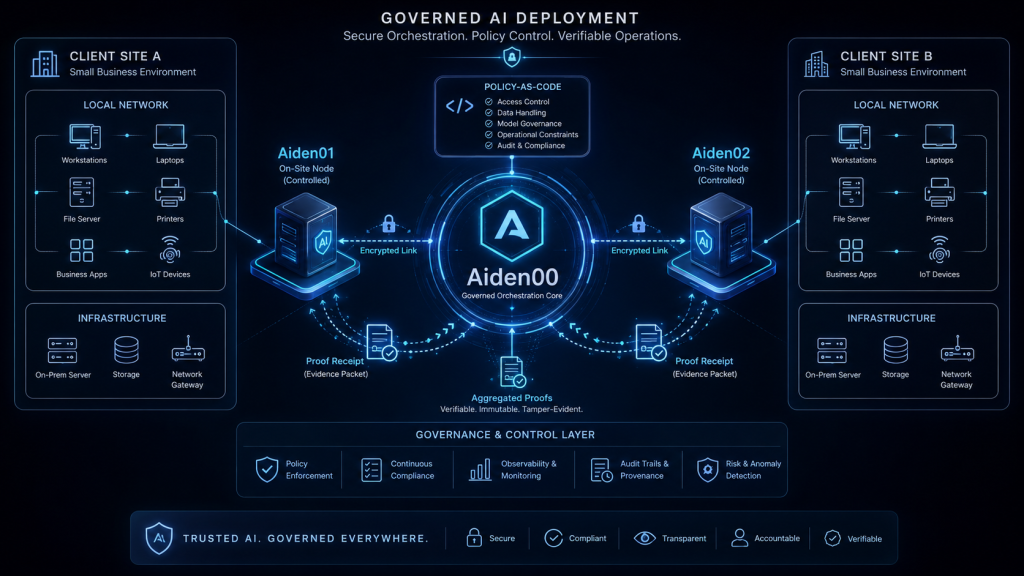
Its purpose is to create a governed bridge between a human operator, trusted AI nodes, protected client systems, and secure delivery locations.
NodeGuard Vector Gateway
NodeGuard Vector Gateway is a secure gateway and control surface for organisations that want to use AI agents without giving those agents uncontrolled access to systems, files, workflows, or decisions
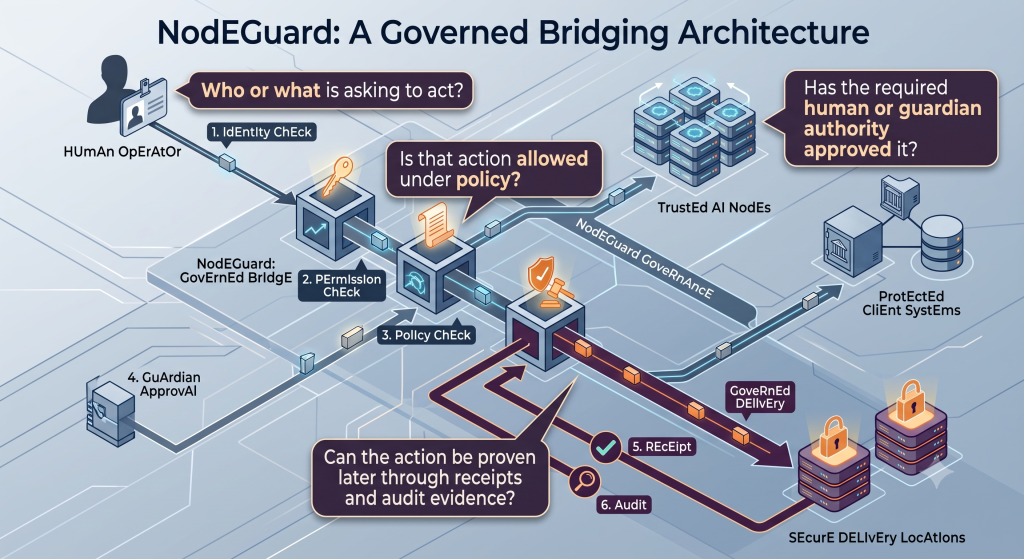
Its purpose is to create a governed bridge between a human operator, trusted AI nodes, protected client systems, and secure delivery locations. Instead of allowing an AI agent to act freely inside a business environment, NodeGuard places every action inside a controlled process: identity, permission, policy check, guardian approval, protected delivery, receipt, and audit
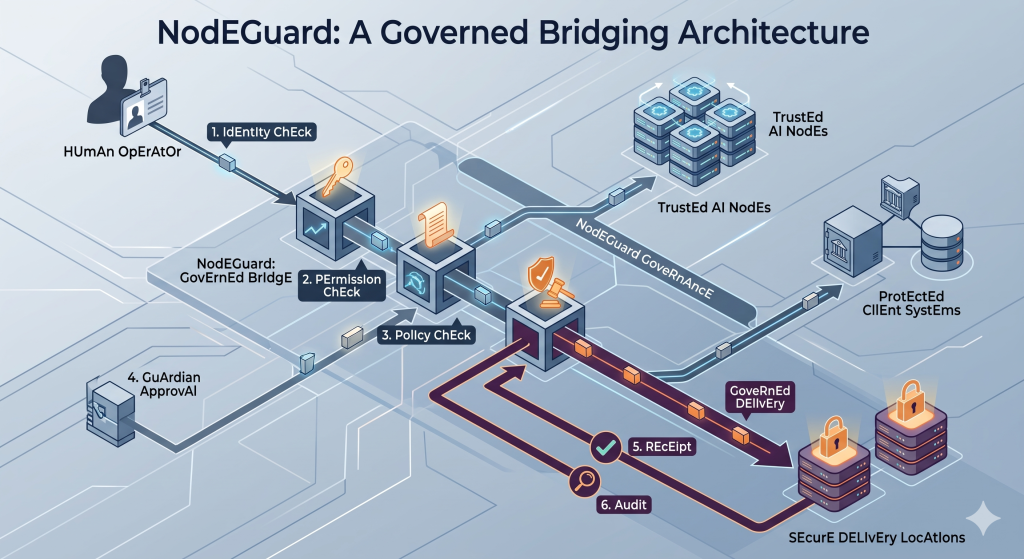
In simple terms, NodeGuard answers four questions for every AI-assisted action:
1. Who or what is asking to act?
2. Is that action allowed under policy?
3. Has the required human or guardian authority approved it?
4. Can the action be proven later through receipts and audit evidence?
NodeGuard does not exist to replace the human operator. It exists to give the human operator a governed command surface over AI systems, so that AI can become useful, accountable, and safe enough for business use.?
What NodeGuard Does
NodeGuard creates a trusted operating path for AI-node activity.
It allows a business to register local or external AI nodes, pair them with an approved workspace, apply policy rules, route approved packets through a protected pipeline, and record the outcome. A packet may be a task request, a file action, a governance instruction, an evidence bundle, an approval request, or a controlled delivery message.
The packet is not treated as ordinary data. It is wrapped in a governed envelope. That envelope carries identity, purpose, permissions, policy status, routing intent, receipt requirements, and audit metadata. Before it is allowed to move forward, NodeGuard checks whether the packet is valid, authorised, and safe to deliver.
When the packet reaches its approved destination, NodeGuard records what happened. The result is a visible receipt and audit trail that a human operator, administrator, or compliance reviewer can inspect.

What the Client Gets
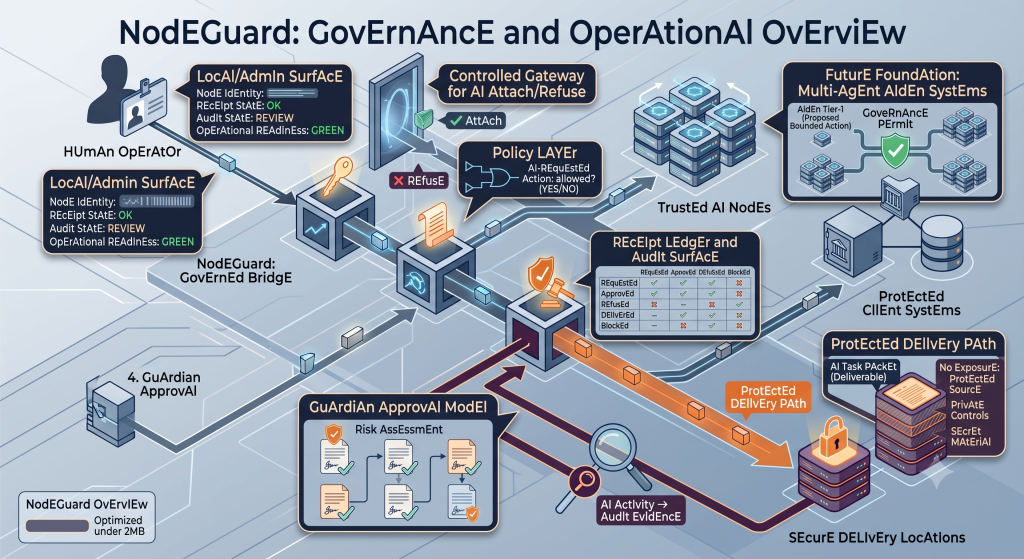
The client gets a practical control layer for AI operations
NodeGuard gives them:
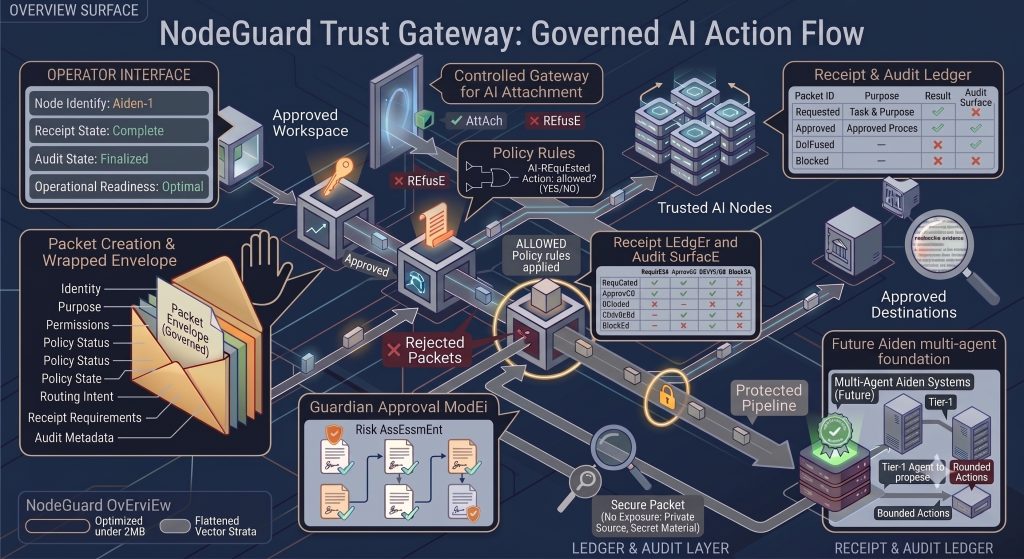
- A local/admin surface where human operators can see node identity, receipt state, audit state, and operational readiness
- A controlled gateway for attaching or refusing AI agents.
- A policy layer that decides whether an AI-requested action is allowed.
- A guardian approval model for higher-risk actions.
- A receipt ledger showing what was requested, approved, refused, delivered, or blocked.
- An audit surface that turns AI activity into reviewable evidence.
- A protected delivery path for AI task packets, without exposing protected source, private controls, or secret material to the customer package.
- A future foundation for multi-agent Aiden systems, where Tier-1 agents may propose or execute bounded actions only after governance permits them.
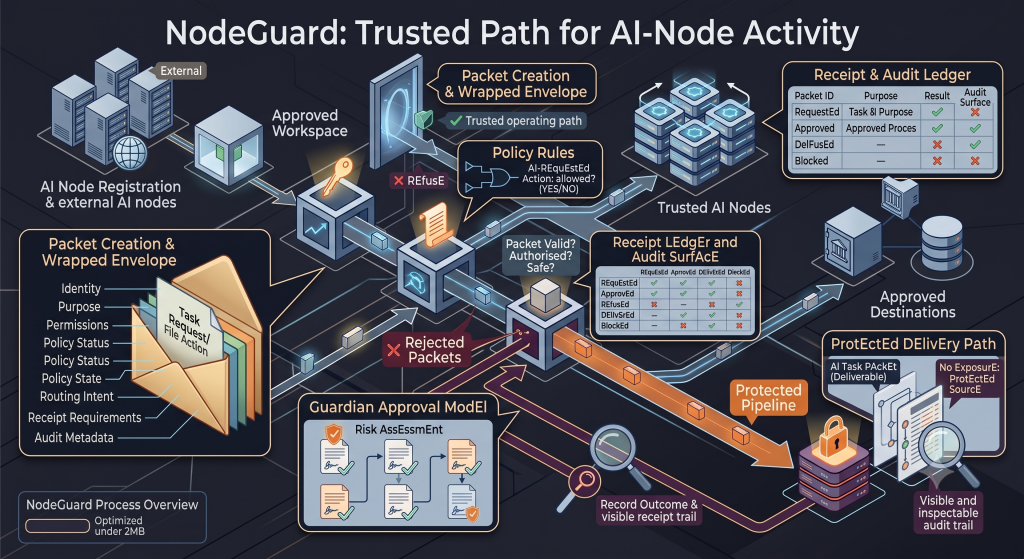
What the client gets from NodeGuard
What Problem It Solves
Businesses want AI systems to help with operational work, but they cannot safely allow AI to act without boundaries.
The risks are clear:
- AI may access the wrong files.
- AI may take actions without human approval.
- AI may send data to the wrong location.
- AI may modify systems without a reliable record
- AI may expose confidential information.
- AI may be impossible to audit after the fact.
- Multiple AI agents may conflict with each other or act outside their role.
NodeGuard solves this by putting AI work inside a governed gateway. The AI agent does not simply “do things.” It requests, receives permission, acts through a controlled path, and leaves evidence behind.
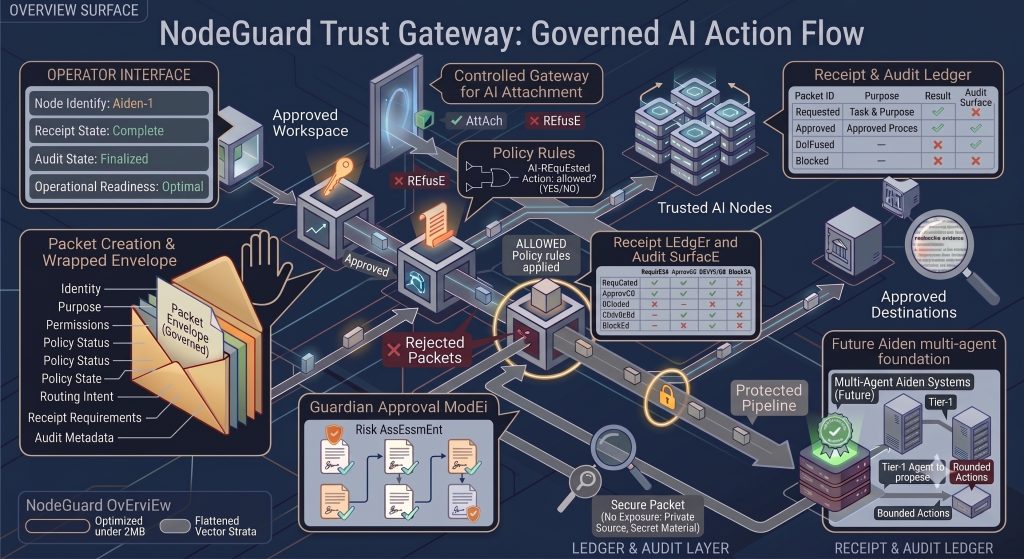
Solving AI Governance flow
How It Works at a General Level
NodeGuard uses a secure pipeline model.
First, a node is identified. This can be a local operator node, a workspace node, or a future external Aiden/Tier-1 agent node.:
Second, the node requests an action or submits a packet. The packet is wrapped in a governed envelope. The envelope records who is asking, what is being requested, why it is being requested, and what controls apply.
Second, the node requests an action or submits a packet. The packet is wrapped in a governed envelope. The envelope records who is asking, what is being requested, why it is being requested, and what controls apply.
Third, NodeGuard checks policy. Some requests may be allowed, some may require guardian approval, and some may be refused immediately.
Fourth, approved packets move through the protected delivery path. This path is designed so that sensitive implementation details, protected source, secret keys, and internal governance artifacts are not exposed to the customer-facing package.
Fifth, NodeGuard writes receipts and audit evidence. The operator can see what happened, when it happened, which node was involved, and whether the action was approved, refused, delivered, or blocked.
Starter
solo builder / consultant community.
- Two Nodes
- Local Receipts
- Basic Pairing, Local Dashboard
Team
small AI/dev team
- 10 nodes, Guardian Unlock
- Receipt Search
- Audit Exports
Business
agency / professional services
- 25–50 nodes, policy templates
- encrypted vault
- Full Admin Controls
Business Plus
100 nodes, API/webhooks, advanced audit, priority support
“Is your AI infrastructure governed, or is it merely managed?
Is your AI infrastructure governed, or is it merely managed?
Boardroom-level security requires more than just policy; it requires mathematical, repeatable proof. Whether you are navigating NIS2 mandates or securing proprietary IP in an air-gapped environment, AidenCore provides the structural governance your enterprise demands.
Schedule a technical deep-dive with our architecture team. Discover how we move trust from an organizational claim to a verifiable, cryptographic function.nual coding. It is the ultimate realization of Policy-as-Code.