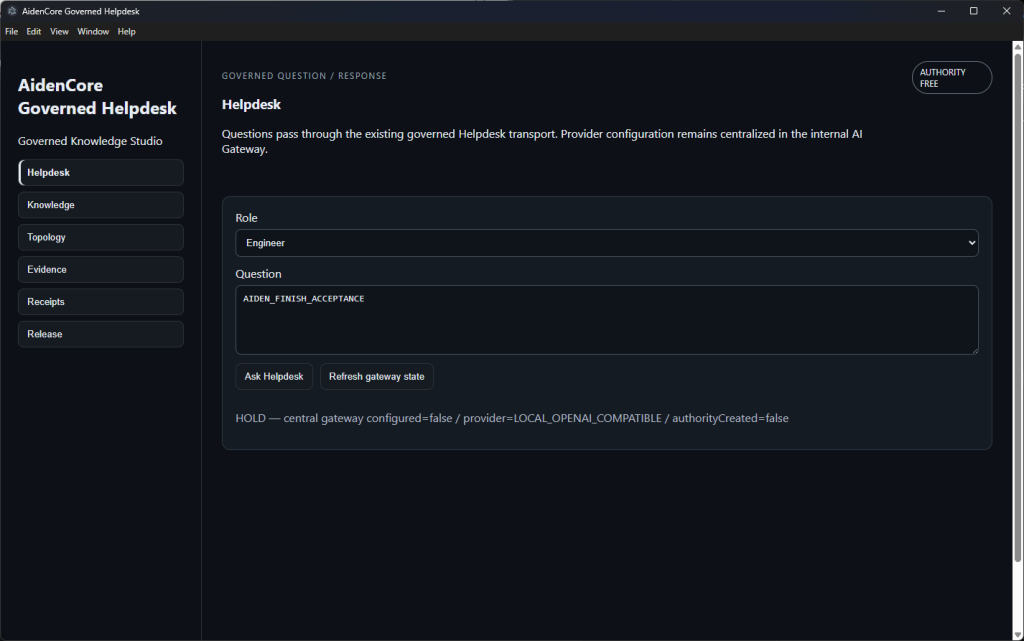
Transform Your Support with an AI-Context Helpdesk
AidenCore AI Helpdesk
Turn a generic AI model into a specialized, context-aware operational expert using structured knowledge packs.
🔍 What Is This Helpdesk?
This is an AI-context helpdesk: a chat assistant built on top of a general-purpose AI model (such as Claude, OpenAI, or Gemini) and given a specific job by loading it with "knowledge packs"—structured reference material about one product, process, or team[cite: 2]. On its own, a general AI model does not know anything about your specific systems, workflows, or terminology[cite: 2]. The knowledge packs are what turn a generic AI model into a helpdesk for a specific purpose[cite: 2]. Different helpdesks are just the same underlying assistant loaded with different packs[cite: 2].
🚀 Why Use It? (The Benefits)
- Ask direct, specific questions the way you would ask a colleague who knows this area well—for example 'How do I do X', 'What does Y mean', or 'What should I check if Z happens'[cite: 2].
- Answers using whatever knowledge packs have been loaded into the current conversation, plus its own general reasoning[cite: 2].
- Acts as a fast first line of guidance without requiring complex coding or live system wiring[cite: 2].
📦 The Knowledge Pack Architecture
A knowledge pack is a file containing structured reference material for the helpdesk—definitions, workflows, decision rules, examples, and anything else it needs to answer questions accurately[cite: 2].
📋 What You Supply to Build Your Helpdesk
To turn this generic helpdesk into one that actually knows your product, process, or team, you supply clear operational details[cite: 2]: