
✴︎ Trust
In
AI
Mathematical Certainty in an Era of Probabilistic AI
The Proof: Why “Trust” Must Be Calculated, Not Claimed
AI at its atomic level follows a predetermined computational path to an adjudication point. It does not decide. It resolves. The path is the architecture. The architecture is either governed or it isn’t.
That is the entire problem with AI trust today stated in two sentences.
Every existing answer to “can we trust AI” is one of three things: a policy document, a statistical claim, or an appeal to the reputation of the organization that built it. None of those are proof. They are arguments. Arguments can be wrong, withdrawn, or contradicted.
You cannot prove trust with an argument. You can only prove trust with a repeatable, verifiable, auditable function that produces the same governed outcome every time, sealed from the first byte.
That is what AidenCore’s governance spine does. That is what the Core Governance Layer (CGL) does. That is what the cryptographically sealed audit journal does. That is what the Pre-Calculated Matrix Consensus Model does.
The golden binary 1—achieved once, sealed, consensus-admitted, axiomatic—is not a claim about trustworthiness. It is the trust. Mathematically. Provably. Repeatably.
The Architecture of Compliance
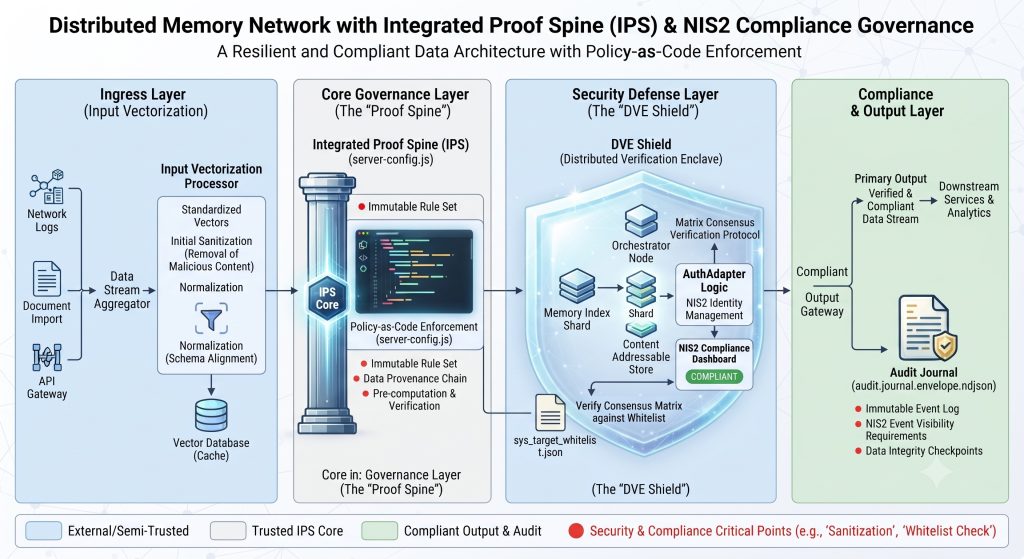
The 4-Stage Operational Pipeline
Stage 1: Input (Raw Data)
Unstructured, raw enterprise data flows into the first processing block. It is isolated and queued for sanitization.
Stage 2: Vectorization (The DVE Shield)
Inside the Distributed Verification Enclave, raw data is broken into multi-dimensional vectors (depicting geometric points in n-dimensional space).
Stage 3: QuorumChain (Immutable Ledger)
The vectorized data is anchored to the chain, utilizing Write-Once-Read-Many (WORM) storage where historical integrity is guaranteed and immune to tampering.
Stage 4: Compliant Output
A final, clean, and verified output package is produced, mathematically aligned with internal policy and fully compliant with NIS2/NIST standards.
4Node Vectorisation: The Market Advantage
In today’s market, enterprise AI security largely relies on superficial API wrappers and basic encryption at rest. These legacy methods are highly vulnerable to prompt injection, data exfiltration, and model drift.
4Node Vectorisation solves this by physically and mathematically decoupling the data payload from the execution logic across a specific topological quorum.
Instead of passing readable text through an AI model, AidenCore shatters the data into geometric representations (vectors) and distributes the workload. Because it requires a multi-node consensus to validate and reassemble the context, a compromised single node yields nothing but useless mathematical noise.
Why it matters today: It guarantees that your proprietary data cannot be passively absorbed or leaked by the underlying LLM. It provides the strict, air-gapped data sovereignty required by NIS2, ensuring that enterprise intellectual property remains entirely under your control.
The CGL Cognitive AAMS State
Understanding how AidenCore “remembers” is critical to understanding how it remains governed. This is achieved through the Core Governance Layer (CGL) and the Aiden Architectural Memory System (AAMS).
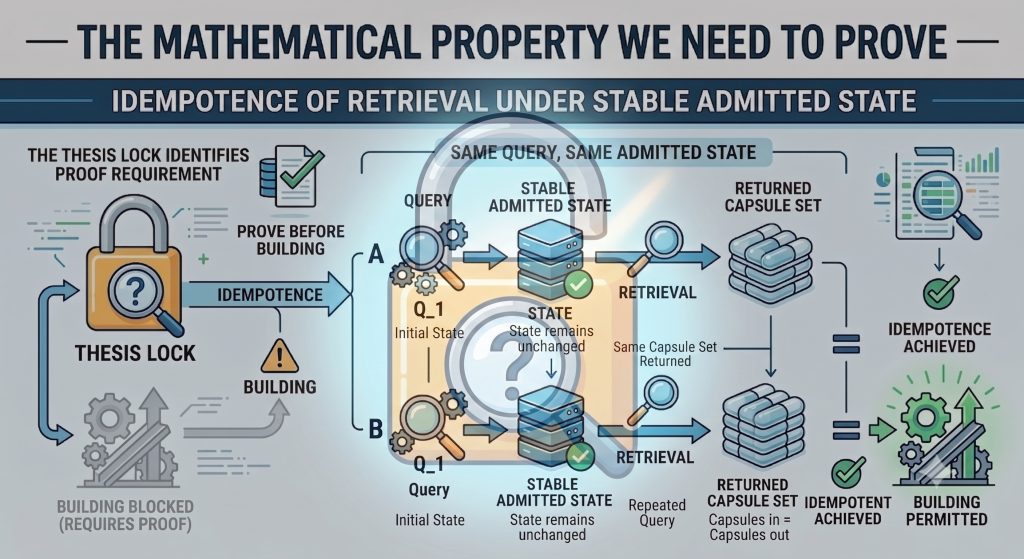
AAMS does not store your raw files. Instead, it operates as a highly advanced, pointer-only indexing system. When the CGL establishes a “Cognitive State,” it takes a cryptographic snapshot of the exact governance rules, vector alignments, and authorization matrices active at that exact millisecond.
The mathematical property we enforce here is Idempotence. As shown in the diagram above, if the admitted state of the system remains unchanged, feeding the exact same query (Q_1) into the system will yield the exact same Returned Capsule Set every single time.
By separating the knowledge of the data from the substance of the data, the CGL Cognitive State ensures zero hallucination and zero unauthorized procedural changes. If the underlying data or policy changes, the “Thesis Lock” triggers, requiring a new mathematical proof before operations can proceed.
“Is your AI infrastructure governed, or is it merely managed?
Is your AI infrastructure governed, or is it merely managed?
Boardroom-level security requires more than just policy; it requires mathematical, repeatable proof. Whether you are navigating NIS2 mandates or securing proprietary IP in an air-gapped environment, AidenCore provides the structural governance your enterprise demands.
Schedule a technical deep-dive with our architecture team. Discover how we move trust from an organizational claim to a verifiable, cryptographic function.nual coding. It is the ultimate realization of Policy-as-Code.