GCRF Explained: Governing Runtime Fabric & The Death of Blind Trust
Episode Summary
Traditional software execution relies on an implicit expectation of blind trust—once a binary is launched, the operating system hands over the keys to the kingdom. In this episode, we dive into AidenCore’s Governed Runtime Fabric (GCRF), exploring how QuorumChain’s epistemic identity control, 4node’s independently addressable authenticated chunks, and pre-governed state machines replace static file encryption with mechanical execution governance.
Key Takeaways
- Epistemic Identity Control (QuorumChain): Moving beyond static file verification to mandatory pre-execution interrogation of object origins, node ownership, and lineage.
- Independently Addressable Chunks (4node): Solving the memory footprint problem by keeping 7.5GB of an 8GB container inert and encrypted on disk while provisioning only micro-chunks into active RAM.
- The Marriage Adapter & Separation of Powers: Strictly separating identity governance from cryptographic storage without ever mixing authority.
- Pre-Governed State Machines ($T_0, T_1, T_2$): Deterministically rejecting unauthorized execution paths and state drift before a single instruction reaches the processor.
The winds of change.
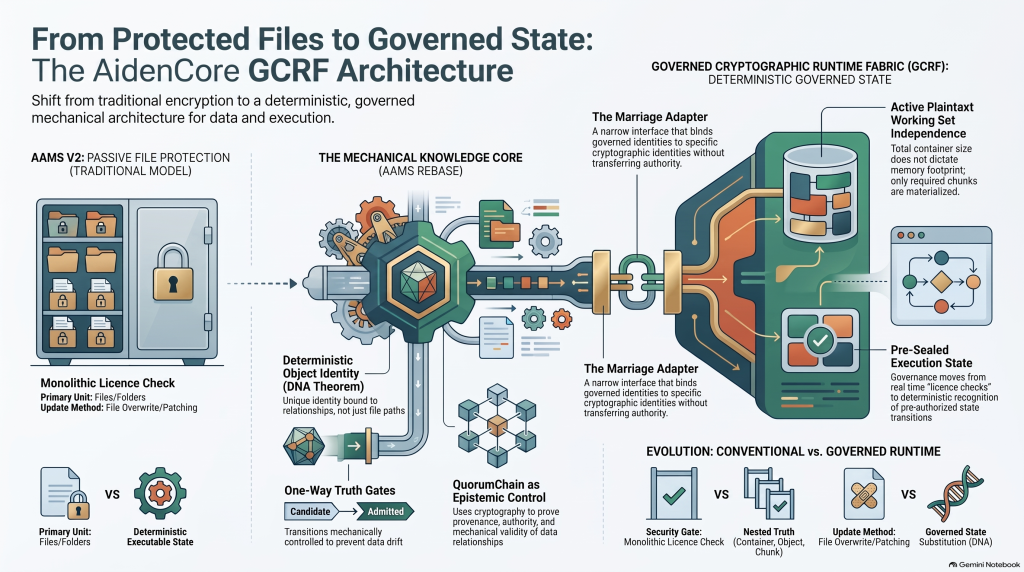
Governing Runtime Fabric & The Death of Blind Trust: Mechanically Governing Executable State
Episode Summary
Traditional software execution relies on an implicit expectation of blind trust—once a binary is launched, the operating system hands over the keys to the kingdom. In this episode, we dive into AidenCore’s Governed Runtime Fabric (GCRF), exploring how QuorumChain’s epistemic identity control, 4node’s independently addressable authenticated chunks, and pre-governed state machines replace static file encryption with mechanical execution governance.
Key Takeaways
- Epistemic Identity Control (QuorumChain): Moving beyond static file verification to mandatory pre-execution interrogation of object origins, node ownership, and lineage.
- Independently Addressable Chunks (4node): Solving the memory footprint problem by keeping 7.5GB of an 8GB container inert and encrypted on disk while provisioning only micro-chunks into active RAM.
- The Marriage Adapter & Separation of Powers: Strictly separating identity governance from cryptographic storage without ever mixing authority.
- Pre-Governed State Machines ($T_0, T_1, T_2$): Deterministically rejecting unauthorized execution paths and state drift before a single instruction reaches the processor.
How AAMS Mechanical Architecture Governs Truth: GCRF & The Death of Blind Trust
Episode Summary
Traditional software execution relies on an implicit expectation of blind trust—once a binary is launched, the operating system hands over the keys to the kingdom. In this episode, we dive into AidenCore’s Governed Runtime Fabric (GCRF), exploring how QuorumChain’s epistemic identity control, 4node’s independently addressable authenticated chunks, and pre-governed state machines replace static file encryption with mechanical execution governance.
Key Takeaways
- Epistemic Identity Control (QuorumChain): Moving beyond static file verification to mandatory pre-execution interrogation of object origins, node ownership, and lineage.
- Independently Addressable Chunks (4node): Solving the memory footprint problem by keeping 7.5GB of an 8GB container inert and encrypted on disk while provisioning only micro-chunks into active RAM.
- The Marriage Adapter & Separation of Powers: Strictly separating identity governance from cryptographic storage without ever mixing authority.
- Pre-Governed State Machines ($T_0, T_1, T_2$): Deterministically rejecting unauthorized execution paths and state drift before a single instruction reaches the processor.
The fear of AI

The AI regulation smackdown isn’t over
At the start of this week, the who’s-who of AI seemed — at least tentatively — on the side of AI regulation. Over the weekend, Anthropic CEO Dario Amodei had proposed a three-step plan for slowing AI development, including by embedding third-party evaluators in labs, coordinating across the domestic industry, and forging international agreements potentially with government assistance. OpenAI CEO Sam Altman, Google DeepMind co-founder Demis Hassabis, and even SpaceX CEO Elon Musk publicly seemed to agree on aspects of all three things.
Anthropic and OpenAI had already been dropping hints that they and other labs were working on some kind of industry framework. Appearing pro-regulation looked like both a good PR move and, potentially, a way for companies to address fallout from progressively more concerning hacking incidents.
For now, any government involvement in this process looks like a non-starter. The Trump administration has attacked the idea of a safety crisis in AI, calling it a “hoax.” The AI world itself is also divided. Meta CEO Mark Zuckerberg quickly came out against limiting companies’ autonomy, and earlier this week, the Wall Street Journal reported that Zuckerberg, Musk, and Nvidia CEO Jensen Huang scuttled proposals for an industry-funded independent regulator for the AI industry — akin to the Financial Industry Regulatory Authority (FINRA), a private nonprofit regulator in finance. But parts of the industry aren’t giving up on the idea, including OpenAI.

“People want to know AI is being developed safely,” Chris Lehane, OpenAI’s global affairs chief, told The Verge. “That begins with the steps companies like ours take on our own, but government has an important role too. The AI policy window is open, with growing bipartisan support for mandatory national safety standards for frontier AI. Congress should turn that momentum into a framework that strengthens safety, supports American innovation, and keeps the U.S. leading in AI.”
An AI venture capitalist, who requested anonymity due to their current investments, agreed that regulation was necessary. “You see these moments in every technology, whether it was electricity, cars, or airplanes, where, at some point, the industry had to come together to find a way to say, ‘How do we collectively embrace what safety means?’ Cars were unsafe, airplanes were unsafe, and then we had to create safety standards that everybody embraced that actually made technology more widespread. But the early days are always a little wild and unruly, and that’s how technology unfolds.”
Anthropic declined to comment, but Amodei wrote in his essay that the company has “always … advocat[ed] for well-considered regulation of AI, even when this gets us accused of hype, ‘doomerism’, or regulatory capture.”
Other companies have remained quiet. Safe Superintelligence Inc., SpaceX, and Google didn’t respond to a request for comment. Thinking Machines Lab declined to comment. And Meta pointed to an X post by Zuckerberg, in which he distanced himself from the calls for a slowdown and regulation, writing, “Every lab has the responsibility and incentive to move at the pace required to train its models safely, and the ability to take its own actions to ensure that happens.”
Zuckerberg’s line of thinking appears in vogue with Trump right now. The president made headlines last week for calling recent fears about AI risks a “hoax.” He called Huang while the latter was onstage at a conference and told a crowd over speakerphone that “The robots will not be taking over.” That same day, he also posted on social media that “the only control or ‘guardrails’ that AI needs is a STRONG AND SMART (High IQ!) PRESIDENT, and the U.S.A. has that, in spades!” He added that the Trump administration has already “stopped AI ‘people’ from doing bad, or potentially bad, ‘things,’” using its existing “tremendous CRIMINAL and REGULATORY power over these companies!” He denounced a “SICK conspiracy” going on against both AI and data centers and that whoever wins AI wins overall. “Conspiracy Theorists, Treasonists, Traitors, and Leakers, BEWARE!” he wrote.
For Nick Reese, an adjunct professor at New York University and the Department of Homeland Security’s former director of emerging tech policy, Trump’s current anti-regulation statements about AI are confusing because he worked with the first Trump administration to develop Executive Order 13960 — which Trump signed and has not been repealed. The order was centered on creating a set of principles for federal AI use that would protect “privacy, civil rights, [and] civil liberties.”
“Six years ago, the Trump Administration signed executive action on AI safety, so there is a real change in the president’s position on the topic,” Reese said. “AI safety requires more than the intellectual abilities of one elected official.”
As AI-industry blogger Zvi Mowshowitz put it, Trump isn’t necessarily fully anti-regulation — after all, he’s the one who slapped some restrictions on frontier labs, like pre-release testing by the government. But he’s driven more by, in Mowshowitz’s words, “vibes” than consistent policy. “Trump’s not yet buying this ‘existential risk’ thing, that’s ‘negative forces,’” Mowshowitz wrote. So government guardrails aren’t exactly ruled out, but they may bear little resemblance to what OpenAI or Anthropic want — let alone the plans of less-powerful, independent AI safety advocates.
Hayden Field
is The Verge’s senior AI reporter. An AI beat reporter for more than five years, her work has also appeared in CNBC, MIT Technology Review, Wired UK, and other outlets

Breaking the Hallucination Machine: Mathematical State Spaces & MVKAE
Episode Summary
In high-stakes industrial and healthcare environments, confident AI hallucinations pose catastrophic operational risks. In this episode, we explore how the Multi-Vector Knowledge Assurance Extension (MVKAE) and pre-sealed state architectures shift AI from an omniscient authority to a deterministic interpreter bounded by strict mathematical rules.
Key Takeaways
- The Floor Formula ($SS_{floor}$): Why semantic matching cannot override missing evidence, using minimum scoring across evidence, topology, and policy.
- Pre-Sealed State Architecture ($T_0, T_1, T_2$): Separating expensive design-time cryptographic governance ceremonies from rapid object arrival and execution.
- QuorumChain DNA Model: Replacing static object IDs with admission grammars and cryptographic lineages for secure runtime validation.
- ETEM + 5D Currentness: Ensuring sealed containers continuously evaluate environmental validity and policy supersession without becoming stale.
Creating a DeepDive in todays Topic. Ending Documentation Drift with AidenCore & AAMS
Episode Summary
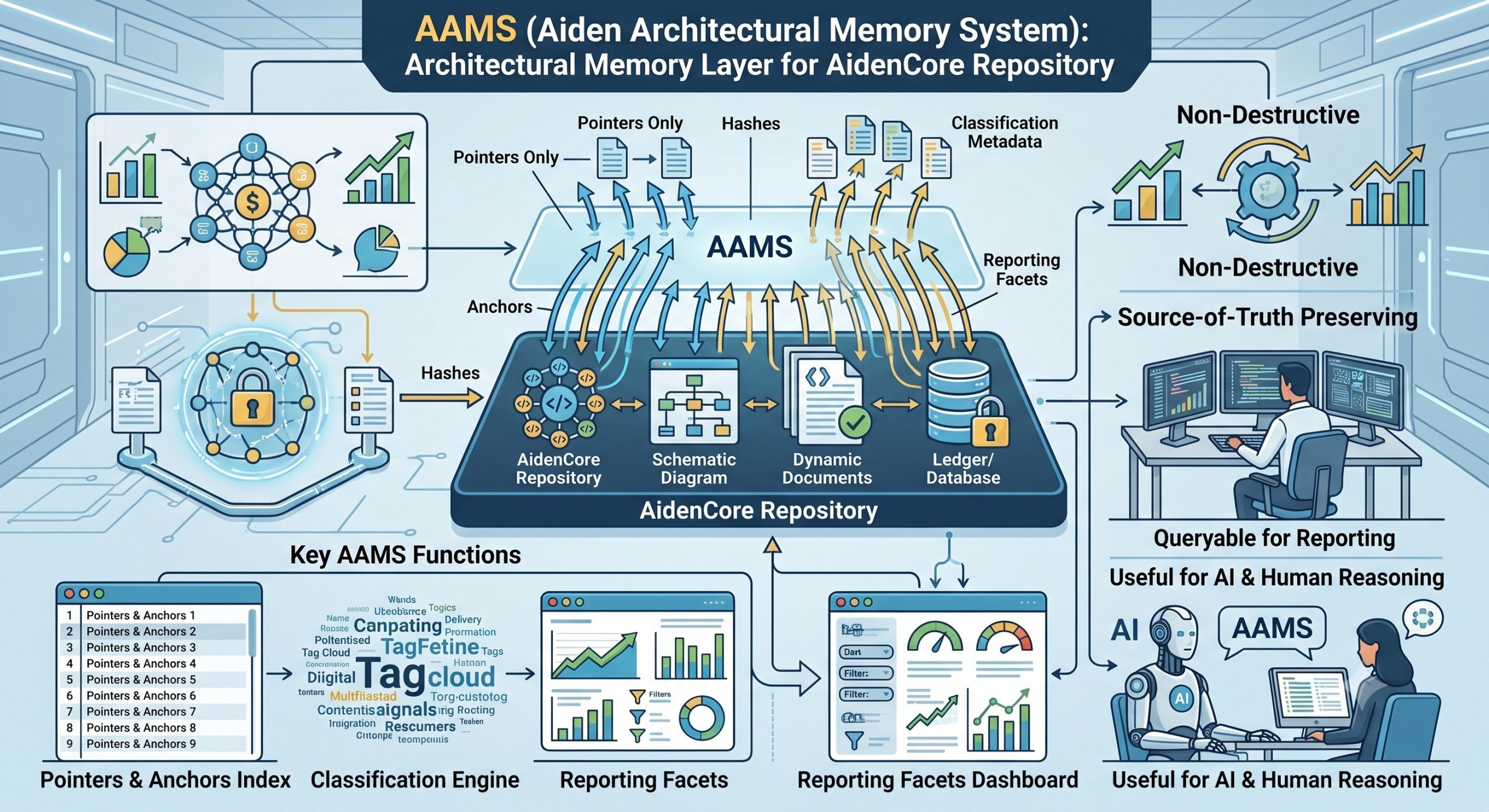
In large software ecosystems, documentation constantly drifts out of sync with actual code. In this episode, we explore how the Aiden Architectural Memory System (AAMS) permanently eliminates documentation drift by enforcing a strict pointer-only, source-of-truth-preserving index[cite: 7].
Key Takeaways
- Pointer-Only Architecture: Why copying code into documentation is an anti-pattern, and how AAMS uses file anchors, SHA-256 hashes, and schema definitions instead[cite: 7, 8].
- AAMS Reporting Facets: How read-only projections generate real-time Security, Compliance, and Daily Operations reports without duplicating repository text[cite: 7, 8].
- Axiomatic Memory Promotion: How AI reasoning and execution traces are safely converted into durable system knowledge through DVE verification[cite: 1, 7].
- NDJSON Fast Discovery Index: How AI agents and human developers reconstruct complete repo architecture in milliseconds[cite: 7, 8].
Cognitive Memory Retrieval
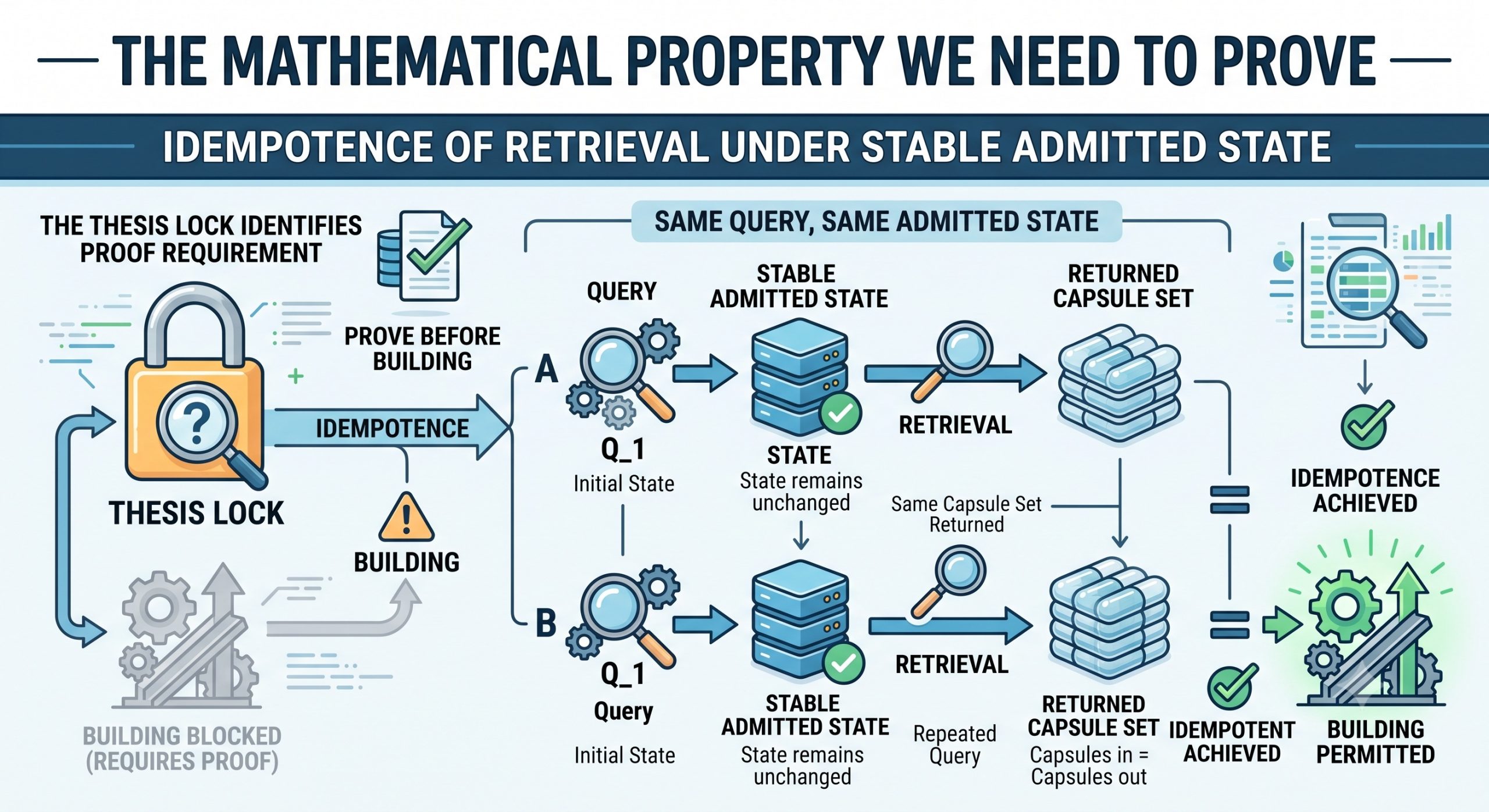
Can we use AAMS to collectively create a layered state across a Tier1’s state? Would a multi-clustered CGL instance , under the governance spine, become a single entity artifact with a near cognitive state?
About Us
Boring Nerds is a description fostered upon us. We dont mind at all. In fact, we take it as a compliment.
Our conversations are far from boring. There are times we see a flash of genius, a bright spark that lifts the mist for all.
Everything we do is for the benefit of all.